



Let's be honest. It's the middle of a work week, and somewhere between a product call, an interview, and the evening investor update, you closed one more deal. Yourself. Because who else.
Nice? Sure. Your product sells, the client said "we're in," the money will land. The problem is that this nice feeling has a price. And the price is your next quarter.
Stay with us to the end: down below there's a two-track diagnostic that takes a few minutes to show your risks and break down, step by step, what to do about them. But first let's figure out what your ceiling is actually made of.
Why every road leads back to you
At the start this is even correct. The founder is the best salesperson in their own company, and there's nothing strange about that. You know the product down to the last bolt. You hear the client's pain before they've put it into words. You're on fire about what you do, and that fire sells better than any script.
And then the company grows. More leads, more conversations, more clients. But the salesperson is the same one - you. The calendar starts bursting at the seams.
Look at two very different companies. A Seed-stage SaaS: the founder personally runs every deal, because "who else will explain the product's value the way I do." And a family-owned German SME, where the whole operation rests on the owner (often also the long-standing director) personally knowing every major client for twenty years. Different businesses. Same disease.
This is not a compliment to your skills. It's a diagnosis.
And you're no exception here. A typical business depends on its owner by about half - the average Owner Dependency Index ≈ 52% (PIN Valuations / Prometis, 2024). In other words, half the company is effectively you. Switch you off for a month, and half the processes simply stop. Sounds like an exaggeration - until you try taking a vacation without your phone.
The simple math that ruins the mood
A rough back-of-the-napkin estimate. Say you run five quality conversations a week - physically more won't fit between everything else. Your conversion is good, let's say 30%. Five times 30% - 1.5 deals a week.
That's your ceiling. Not "roughly." Exactly.
And here's the cruel joke: the better you sell in person, the more reliably you wall in your own ceiling. Because when it works - why change anything? Deals keep coming, the numbers keep rising. And then comes the day you wake up a CEO working as the most expensive sales manager in the company. With the one difference that this manager also has to run everything else in parallel.
Researcher Noam Wasserman (Wasserman, 2012; HBR, 2025) has a name for this - the leadership plateau. The skills that launch a business and the skills that scale it are different skills. What made you a great founder-salesperson won't automatically make you the person who can build a sales department. And that's fine. What's not fine is missing the moment when one turns into the other.
McKinsey worked out one more unpleasant thing (McKinsey, 2024): 78% of companies that have already found product-market fit - meaning the market wants the product, the money is there, the demand is there - still fail to scale. The main reason, per McKinsey, is leadership overload. An overloaded founder who can't hand decisions further down. Not the product's fault. Not the market's. The founder, who became the bottleneck.
It's not a talent problem. It's a documentation problem
The usual attempt to fix this looks like this. The founder finally exhales: "That's it, I'm hiring a salesperson." Hires one. Waits a month, then another. The numbers are weak. The founder sighs, takes sales back "because I'm faster anyway," and returns to the starting point - only now also disillusioned with "all these salespeople."
Sound familiar? The problem is almost never the person. You handed them the wheel but didn't give them a map.
Because everything that makes you a strong salesperson lives inside your head. Who your ideal client is and how they differ from "just a client." Which questions to ask to figure out in five minutes whether it's worth the time. What to say to "too expensive." When to push and when to let go. Researchers call this knowledge tacit knowledge - unspoken knowledge (Nonaka & Takeuchi, 1995). It isn't written down anywhere except in your experience, which is exactly why it's so hard to transfer.
And here's the trap. Intuition can't be delegated. You can only delegate what's written down. As long as your sales motion exists only as a feeling of "I just know how this works" - you can't hand it to anyone. You can only sit a person next to you and hope they somehow guess.
A small but important detail. "Just document everything" doesn't work either. That's a separate anti-pattern (Engineering Management Journal, 2025). Sitting down to write an 80-page sales bible no one will open is a wasted weekend. Knowledge is carried over by hand: through working together, when the newcomer sits in on your calls and you sit in on theirs, through tandem work and debriefing real deals. The document is a support, not magic.
Checklist: what you actually need to hand your first salesperson
Here's the minimum, without which a new salesperson is doomed. Not theory - concrete artifacts that must exist outside your head:
- A one-page ICP. Who your ideal client is. Not "everyone who'll pay," but a portrait: size, pain, trigger to buy.
- Qualifying questions. 5-7 questions that, in the first conversation, filter out the people not worth spending time on.
- A first-conversation structure. Not a word-for-word script, but a skeleton: where to start, where to steer, how to close.
- Pricing and authority limits. How much of a discount someone can give on their own, and where they have to ask you.
- An objection bank. "Too expensive," "we need to think," "competitors are cheaper" - with rehearsed answers to each.
- The entry point. Where leads come from and what to do with them in the first hour.
- CRM and deal stages. Where everything is logged and what each stage of the funnel means.
- 2-3 proofs or case studies. Concrete client stories that close doubts instead of you.
- A handoff rule. Who picks up the client after signing, when, and how.
Look at this list honestly. Put a check where the artifact actually exists - written down, accessible, not "in my head." And a cross where it doesn't, or where it's "well, I'd explain it if asked."
If you have fewer than half checked - there's your answer for why sales won't scale without you. Not because you're irreplaceable. Because there's physically nothing yet to replace you with.
The same dependency lives outside of sales too
Now the most unpleasant part. Sales is just the most visible part. That same dependency has usually spread across the whole company - it's just quieter elsewhere.
Decisions. How many questions a day fly off to "ask the founder"? The color of a button, the wording of a client email, whether to give a discount, whether to take this project. McKinsey (2023; the Bain RAPID model) showed a nice thing: companies with clear decision rights - where every decision has one explicit owner - grow roughly 2.5x faster. It's a comparative estimate, not a magic formula. But the logic is simple: decisions don't get stuck in a queue to one person.
Knowledge. The same tacit knowledge, only now not about sales but about everything. How you negotiate with a supplier. Why client X is touchy and how to handle them. Where all the rakes are buried from the last five years. If this doesn't get out of your head - the company is worth exactly as much as you are. And unlike a system, you can't be duplicated - you get sick, you get tired, and you're entitled to a vacation.
The team. Here a subtle psychological thing kicks in, which Manfred Kets de Vries of INSEAD (Kets de Vries, 2023) called the rescuer syndrome. It sounds grand and works simply: a leader who constantly rescues everyone unconsciously grows a team that can't rescue itself. "I'll handle it" - and the team learns not to handle it. Every heroic rescue of yours comes back tomorrow as a new question no one can answer without you.
Business value. And this is about money, very concrete money. When a business depends on one person, its market price drops. It even has a name - the key-person discount (Shannon Pratt). On a sale it usually eats 10-25% of the value. In the DACH region the official BVS valuation standard (BW1, 2024) records a 15-20% reduction if the business is tied to its owner. It's worth separating two different figures here so they don't get confused. First, the one-time discount at sale: a systematized business might be valued at ~€2.0M, while the same business but tied to its owner - at ~€1.5M. That's minus a quarter, about €500,000 in one shot when you exit the deal. Second, a separate benchmark: roughly €50,000 of un-created value per year - what the company failed to add because it rests on one person. These are different magnitudes: one is about the moment of sale, the other about an annual "leak."
And here's how un-abstract this is. A natural experiment on 73,500 firms (Becker & Hvide, 2022) showed: when a business suddenly loses its founder-owner, sales drop 60% over four years. Sixty percent. Because half of what's written down nowhere leaves along with the person.
The root is twofold: psychology and an un-extracted system
So why do we so stubbornly keep everything on ourselves? The root always has two parts.
- The first is mechanical. There's simply no system. Knowledge isn't extracted, decisions aren't mapped, artifacts don't exist. This is cured by hand: build, document, hand off. Boring, but clear.
- The second is psychological, and it's trickier. Here you have perfectionism ("no one will do it as well"), and distrust, which quietly grow into micromanagement (Vu, 2025). Here's the "control versus wealth" dilemma (King vs Rich, Wasserman, 2012): King-type founders cling to control even when it costs them the company's value. Not because they're foolish. Because letting go is scary.
And let's dispel one comforting myth. There's a temptation to think: "at least I'm my own boss, it's easier for me than for employees." A meta-analysis across 82 countries (Stephan, Rauch & Hatak, 2023) says otherwise: entrepreneurship does not reduce stress and anxiety compared with employment. So the thesis about the calm of self-employment isn't supported. "I carry it all myself" isn't about calm. It's about burnout with a deferred invoice.
For a sense of scale (Porter & Nohria, HBR, 2018): the average CEO spends only 43% of their time on their own agenda. More than half your week is eaten by someone else's agenda. The question isn't whether you work a lot. The question is on what.
What this has to do with urgency
If it feels like a "I'll deal with it someday later" - one fact from DACH (KfW, 2026). Every year roughly 109,000 SME owners want to step away from the business. And 69% can't find a successor. Not because no one wants to buy or lead it. Because the business doesn't work without them. It can't be handed over, because it is the person.
Meanwhile, in German B2B, sales still largely remains the leader's personal affair (Atreus, 2025): 71.7% of top managers consider sales "very important," and 78.5% rely on direct selling. So the problem we started with - the founder as chief salesperson - is not the quirk of an odd startup. It's a mass model that, a few years on, turns into 109,000 businesses a year with no one to hand them to.
What to do about it this very week
The good news: the way out requires neither budget nor an immediate hire. It requires honesty and one shift in your head.
Delegate decisions, not just tasks (Johnson, HBR, 2025). The difference is enormous. "Do this, this way" is handing over hands. "Here's the context, here are the limits, decide for yourself" is handing over the head. There's a simple 80% rule: if another person will do it at least 80% as well as you - give it away. Those 20% of "perfection" usually cost you far more than they're worth.
And for sales there's a path well-tested in venture practice (Bessemer, 2025; a16z, 2018; SaaStr, 2025). Up to roughly the first $100k ARR the founder really does sell themselves - and that's right. The first hire isn't an expensive VP of Sales, but a couple of ordinary salespeople. And the main condition, without which it's too early to hire: you have to be able to articulate your own sales motion. A simple test - explain out loud exactly how you closed your last five deals. If a coherent logic comes out, rather than "well, I just closed it somehow" - it can already be handed over. If it doesn't - there's your homework for the coming weeks.
Where to start: an honest diagnostic
Everything above is fine theory until you try it on your own business. So we built a short diagnostic, "Engine or Brake of Your Own Business?" - a few minutes of honesty about whether you're still accelerating your business or already holding it back yourself.
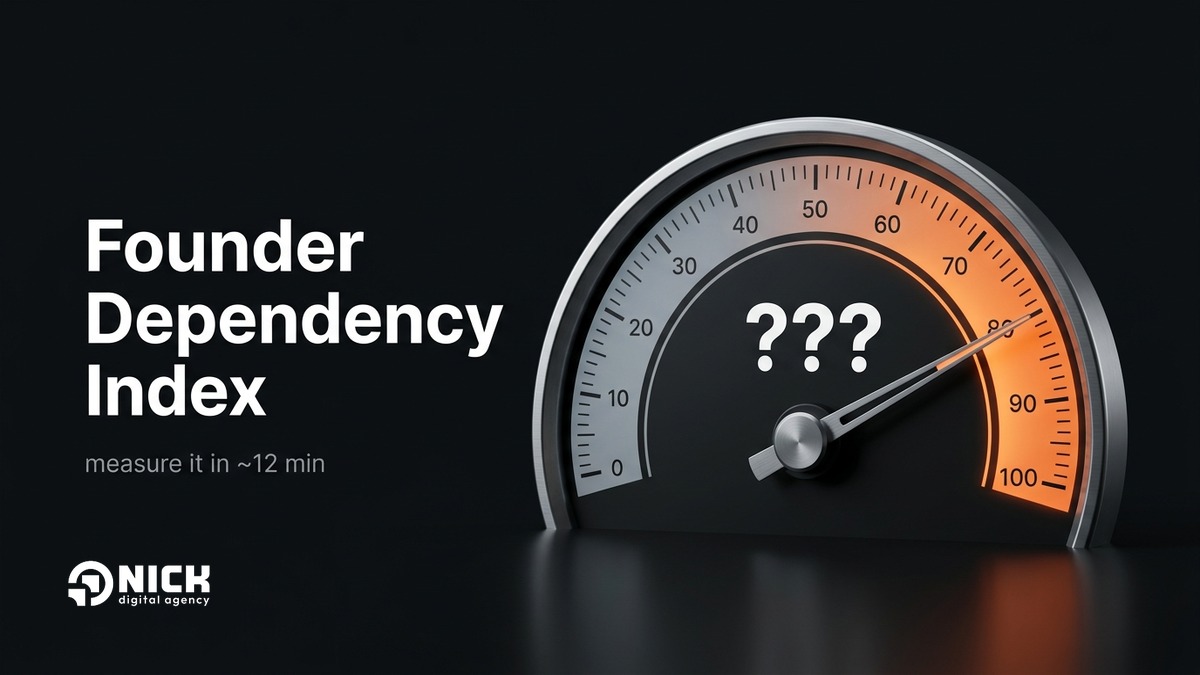
It's 28 questions across 7 dimensions: your mindset, sales, operations, decision concentration, how documented your knowledge is, team autonomy, and financial-strategic dependency. So not just the sales we started with, but the whole picture.
At the end you'll get:
- One number - your level of dependency from 0 to 100%. No sugarcoating.
- Three main levers where decoupling will give the biggest effect in your specific case.
- Ready steps for this very week - with no hiring and no budget.
- An estimated cost of inaction in euros per year. The same un-created value, only calculated for you.
And the most important thing about the format. You take it yourself and see the result on screen right away. The Founder Dependency Index - an honest number and recommendations.
What to do with it next is also up to you. Maybe your business has a low dependency index and you simply breathe out. Maybe the root is in mindset and decisions - then it makes sense to work on it personally with an executive mentor/coach. Or maybe the root is mechanical, in sales and processes - and then, if you want, that's our work: to build the system. But that's for later, a separate conversation.
Every deal you close yourself is a small win and a small nail into your own ceiling at the same time. First - just look at the number. Then we'll see.